
Crypto Intelligence Decoded: Institutional Analysis, RWA, and DeFi Risk Frameworks
The digital asset market has undergone a fundamental transition from a retail-driven speculative phase into a sophisticated, institutional-grade financial ecosystem.
At fakto.top, we eliminate the pervasive market noise to provide high-fidelity intelligence for investors and professionals who demand structural clarity before capital commitment.
We do not chase “meme coin” pumps, nor do we echo the fleeting sentiments of social media influencers. Instead, we focus on decoding complex tokenomics, auditing smart contract architecture, and dissecting the massive regulatory shifts shaping the future of global finance.
Our mission is to provide a comprehensive, usable framework for navigating decentralized systems with technical precision and long-term strategic foresight.
The Foundations of the New Economy: Infrastructure, RWA, and Compliance
In the 2025 cryptocurrency landscape, the ability to distinguish between market price and intrinsic protocol value depends entirely on a deep understanding of underlying engineering mechanics.
Our research hub is structured across three foundational pillars that define the next era of global value transfer: the institutional integration of Real-World Assets (RWA), the technical resilience of DeFi protocols, and the evolving jurisdictional regulatory frameworks that govern digital ownership.
1. Real-World Asset (RWA) Tokenization and Fractional Liquidity Mechanics
The convergence of Traditional Finance (TradFi) and On-Chain Finance represents the most significant liquidity migration in modern history. RWA tokenization is not merely a method for recording assets on a blockchain; it is the fractionalization of illiquid markets and the creation of highly programmable securities. At fakto.top, we analyze how physical assets—ranging from sovereign treasury bills to commercial real estate—are being transformed into digital primitives that can move at the speed of the internet.
- Institutional Liquidity Infusion: We track how global asset managers like BlackRock, Fidelity, and Franklin Templeton utilize public ledgers (Ethereum, Solana) and Layer 2 solutions for T+0 settlement. This shift significantly reduces counterparty risk by eliminating the inefficiencies of legacy T+2 clearing cycles and centralized custodians.
- Tokenized Treasury Bills (On-Chain T-Bills): Our comparative analysis explores the yield transparency and redemption mechanics of protocols such as Ondo Finance, MakerDAO, and Mountain Protocol. We examine the spread between traditional Treasury yields and on-chain synthetic representations, focusing on how collateral is managed and audited in real-time.
- Legal Wrappers and SPV Structures: Understanding the bridge between legal code and software code is critical. We dissect how Special Purpose Vehicles (SPVs) are utilized to legally bind physical property to ERC-20 standards, ensuring that token holders possess enforceable rights across multiple jurisdictions.
- On-Chain Private Credit: We evaluate the emergence of decentralized credit markets where corporate debt is financed through transparent, collateralized pools. This eliminates traditional banking intermediaries and provides direct yield opportunities for protocol participants.
- Regulatory Reporting for RWAs: As tokenized assets fall under securities laws, we analyze the integration of KYC/AML directly into the smart contract layer, allowing for permissioned liquidity that satisfies institutional compliance requirements.
2. Advanced DeFi Infrastructure and Multi-Layer Risk Assessments
Decentralized Finance (DeFi) serves as the primary laboratory for modern economics. With over 36 technical breakdowns, our DeFi research hub helps you navigate liquidity pools and yield-generating strategies by focusing on the security-to-yield ratio. We maintain that yield without a clear understanding of its origin—whether it be inflationary token rewards, trading fees, or lending interest—represents an uncalculated systemic risk.
- Smart Contract Logic Audits: We move beyond the “audit badge” marketing to evaluate specific logic flaws, oracle dependencies (Price Feed manipulation risks), and administrative “god mode” keys that could compromise protocol decentralization.
- Liquid Restaking Tokens (LRT): We provide an in-depth look at the “leverage stacking” risks within the EigenLayer ecosystem. Our research analyzes how re-hypothecated security models affect the base layer stability of Ethereum and the potential for cascading liquidations.
- Interoperability and Cross-Chain Bridges: Technical evaluations of Chainlink CCIP, LayerZero, and Wormhole. We analyze how these protocols attempt to solve liquidity fragmentation while mitigating the inherent risks of “lock and mint” vs. “burn and mint” mechanics.
- Automated Market Makers (AMM) and Capital Efficiency: Understanding concentrated liquidity (Uniswap v3 and v4) and how professional liquidity providers manage Impermanent Loss through delta-neutral strategies and automated rebalancing.
- Flash Loans and Governance Attacks: We dissect how sophisticated actors utilize uncollateralized loans to influence DAO voting or exploit arbitrage opportunities within fragmented liquidity pools.
3. US Regulatory Compliance and Global Crypto Taxation Frameworks
For investors operating within the United States and Tier-1 jurisdictions, regulatory compliance is no longer an optional hurdle—it is a strategic competitive edge. We provide the unvarnished technical truth regarding IRS mandates, SEC enforcement actions, and the evolving legal classification of digital assets as they move through the judicial system.
- IRS Reporting and Form 8949 Precision: We offer comprehensive guides on cost-basis tracking using FIFO, LIFO, and HIFO accounting methods. This includes the complex taxation requirements for high-frequency trading, airdrops, forks, and DeFi “wrapped” tokens.
- The Howey Test in the 2026 Context: Analyzing current legal precedents that determine whether a utility token or a DAO participation right is classified as a security or a commodity. We track the ongoing friction between the SEC and the CFTC.
- KYC/AML and Zero-Knowledge Privacy: Navigating the trade-offs between institutional “permissioned” DeFi and the core ethos of pseudonymity. We examine how protocols utilize ZK-proofs to provide compliance data to regulators without compromising the underlying user data or financial privacy.
- Tax-Loss Harvesting Strategies: Practical guides on using market volatility to optimize annual tax liability. We explore the nuances of the wash-sale rule as it currently applies to digital assets compared to traditional equities.
Mastering Self-Custody: Advanced Wallet Architecture and HSM Security
In the digital asset space, your wealth is only as secure as your custody layer. We move beyond “Seed Phrases 101” to explore the sophisticated technology required to protect high-net-worth portfolios. Security is a continuous process of proactive risk mitigation, not a static product you purchase once.
Our research into Multi-Party Computation (MPC) and Threshold Signature Schemes (TSS) explains why institutional investors are shifting away from single-point-of-failure hardware wallets. We analyze the role of Hardware Security Modules (HSM) in enterprise-grade custody and how retail users can implement “Social Recovery” wallets using account abstraction (ERC-4337). Furthermore, we provide detailed checklists for auditing smart contract approvals, ensuring that a single malicious signature cannot compromise your entire cold storage vault. We emphasize the importance of Multi-Sig (Safe) setups for managing DAO treasuries and family offices, where collective oversight is mandatory.
The Technical Stack: Layer 1, Layer 2, and Data Availability
To understand the future of crypto, you must understand its physical and software infrastructure. With 24+ dedicated reports on Blockchain Infrastructure, we break down the fierce competition for blockspace. We analyze the scalability trilemma—Decentralization, Security, and Throughput—through the lens of modern software engineering.
- Ethereum’s Rollup-Centric Roadmap: Comparing Optimistic Rollups (Arbitrum, Optimism, Base) versus ZK-Rollups (ZK-Sync, Starknet). We evaluate data availability (DA) layers like Celestia, Avail, and EigenDA and their role in drastically reducing transaction costs for the end-user.
- Parallelized Execution Environments: A deep dive into Solana’s Sealevel engine and Move-based blockchains like Aptos and Sui. We examine how parallel transaction processing enables high-frequency trading and mass-consumer applications that require sub-second finality.
- Modular vs. Monolithic Architectures: We explain the industry shift toward modularity, where execution, settlement, and data availability are handled by different specialized layers, versus the integrated efficiency of monolithic chains like Solana or Monad.
- Node Infrastructure and Decentralization: Analyzing the geographical distribution of validators and the impact of cloud hosting dominance on the censorship resistance of major networks.
Digital Identity and the Evolution of Web3 Governance
Web3 is fundamentally more than finance; it is a new model for digital sovereignty and data ownership. We explore the 26+ pages of our NFT and Web3 research, focusing on utility and identity rather than speculative art. The future of the decentralized internet lies in decentralized identity (DiD) and the ability for users to own their social and financial graph.
We analyze DAO Governance (Decentralized Autonomous Organizations), examining how billion-dollar treasuries are managed through on-chain voting mechanisms. We address the “Voter Apathy” problem and how delegation models are attempting to create more resilient decentralized political systems. From Ethereum Name Service (ENS) to Soulbound Tokens (SBTs), we decode the cryptographic tools that will define your digital presence and reputation in the coming decade. We also look at the intersection of AI and DAOs, where automated agents perform treasury management and protocol optimization.
Economics, Ethics, and the Philosophy of Decentralization
Why does crypto exist? Our Crypto Ethics section explores the socio-economic motivations behind the birth of Bitcoin and the ethos of “Sound Money.” We analyze the impact of deflationary assets on global inflation and the ethical considerations of building “Code as Law” systems. We discuss the inherent tension between total blockchain transparency and the human right to financial privacy, providing a balanced view of how blockchain technology could reshape the social contract between citizens and states. We also delve into the ethics of “Airdrop Farming” and the impact of sybil attacks on the decentralization of new networks.
Advanced Crypto Trading and Liquidity Mechanics
Trading in the digital asset space requires a different toolkit than traditional equities. We provide 11+ reports on Crypto Trading, focusing on the deep mechanics of the market rather than superficial technical analysis patterns. We believe that understanding liquidity and order flow is the only way to survive the volatility of the crypto markets.
- P2P Trading and Global Arbitrage: How to identify price discrepancies across global exchanges and the risks associated with “slippage” in low-liquidity pairs.
- Maximal Extractable Value (MEV): Analyzing how “Searchers” and “Builders” reorganize blocks for profit and how this affects the average user’s transaction execution and slippage.
- Derivatives and Perps: A technical look at Perpetual Swaps, funding rates, and the mechanics of on-chain leverage through protocols like GMX and dYdX. We explain how liquidations work and how to audit “Health Factors” in lending protocols.
- On-Chain Data Analysis: Using tools like Glassnode and Dune Analytics to track “Smart Money” movements and exchange inflows/outflows as a sentiment indicator.
A Comprehensive Deep Dive into Category Intelligence
Fakto.top is more than a news site; it is a structured repository of blockchain knowledge. Our content is architected to lead you from foundational theory to professional-grade execution across several key domains.
The Infrastructure Layer (24+ Reports)
Without hardware and nodes, there is no blockchain. We analyze the consensus mechanisms that secure trillions in value, from the energy consumption of Proof of Work (PoW) to the slashing risks of Proof of Stake (PoS). Our reports include technical audits of RPC providers, indexing protocols like The Graph, and the decentralized storage solutions (Filecoin, Arweave) that prevent Web3 from relying on centralized servers.
The DeFi & RWA Frontier (38+ Reports)
The synergy between decentralized protocols and real-world assets is creating the first truly global, 24/7 financial market. We study the architecture of algorithmic stablecoins, the collateralization ratios of CDP (Collateralized Debt Position) protocols, and the emergence of “Restaking” as a new security primitive. We provide jurisdictional comparisons for RWA issuance, looking at why certain protocols choose Switzerland, Singapore, or the BVI for their legal headquarters.
Security, Custody, and Risk Management (14+ Reports)
In a “Permissionless” world, you are your own bank, which means you are also your own security officer. We provide frameworks for Smart Contract Approval Management, teaching users how to use tools like Revoke.cash to limit their exposure. We analyze the history of major DeFi hacks to extract lessons on re-entrancy attacks, oracle manipulation, and economic exploits.
Taxation, Legal, and Compliance (4+ Specialized Guides)
As the “Wild West” era of crypto concludes, the “Compliance” era begins. We track the implementation of MiCA in Europe, the Lummis-Gillibrand bill in the US, and the global efforts by the FATF to regulate virtual asset service providers (VASPs). Our taxation guides are updated for the 2025 tax season, providing clarity on everything from NFT royalties to liquidity provider (LP) token rewards.
Explore Our Full Intelligence Hub
With over 400 pages of structured, data-driven analysis, fakto.top is designed to be your primary research partner in the digital asset space. Our content is meticulously interlinked to ensure a seamless learning journey from basic onboarding to institutional-level strategy.
- Crypto for Beginners: 13+ foundational guides covering private keys, exchange security, and safe onboarding.
- Crypto Infrastructure: 24+ deep dives into the hardware and software layers of the blockchain stack.
- DeFi & RWA: 38+ combined reports on the future of decentralized and tokenized finance.
- Security & Custody: 14+ essential guides on protecting high-net-worth digital portfolios.
- Taxation & Legal: Professional-grade analysis of US and global regulatory requirements.
- Web3 & NFTs: 30+ reports on digital identity, utility-based NFTs, and the decentralized web.
- Travel with Crypto 2026: Hack Your Trips & Skip Bank Fees
 Travel with Crypto 2025–2026: How to Hack Your Trip and Skip Bank Fees In 2025, traveling with a traditional bank card is still a… Read more: Travel with Crypto 2026: Hack Your Trips & Skip Bank Fees
 - Yield Loop: Operational Manual for Triple-Digit DeFi Returns (2026)
 Yield Loop 2026: The Definitive Operational Manual for Advanced DeFi Yield Generation As the Ethereum ecosystem transitions into a mature restaking-prime environment in 2026,… Read more: Yield Loop: Operational Manual for Triple-Digit DeFi Returns (2026)
 - Bank Crypto Limits 2026: Why Your Card is Declined & How to Bypass
 The Silent Cap: Why US Banks are Secretly Throttling Your Crypto Purchases in 2026 It’s 2026. You’re not doing anything exotic. No darknet, no… Read more: Bank Crypto Limits 2026: Why Your Card is Declined & How to Bypass
 - Crypto On-Ramps in the US 2026: The Ultimate Guide to Instant Buys
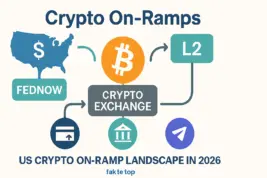 The Definitive US Crypto On-Ramp Guide for 2026 The landscape of digital asset acquisition has fundamentally transformed, making a seamless US crypto on-ramp no… Read more: Crypto On-Ramps in the US 2026: The Ultimate Guide to Instant Buys
 - Mastering Compliant DeFi in the US: 2026 Tactical Guide for Institutional & Advanced Users
 Mastering Compliant DeFi in the US: A 2026 Tactical Blueprint Notice: This guide is provided for informational purposes for the 2026 fiscal year and… Read more: Mastering Compliant DeFi in the US: 2026 Tactical Guide for Institutional & Advanced Users
 - Gemini Prediction Markets License: CFTC Regulated Crypto Event Contracts USA
 Gemini Prediction Markets: Licensed Crypto Event Trading in the US The Gemini prediction markets license issued by the CFTC marks a rare moment where… Read more: Gemini Prediction Markets License: CFTC Regulated Crypto Event Contracts USA
Transparency and Editorial Independence
To maintain our position as a leading independent intelligence hub, fakto.top operates under a strict code of intellectual honesty. We do not participate in “Pay-to-Play” schemes, and we categorically reject sponsored content that masquerades as independent analysis. Our revenue is generated through transparent advertising networks and clearly marked affiliate partnerships, ensuring that our high-level research remains free and accessible to the public without compromising our editorial integrity. We publish what the data reveals, providing you with a raw, unvarnished look at the digital asset ecosystem. Our focus remains on the long-term viability of protocols, the robustness of their code, and the transparency of their governance models. fakto.top is built for the reader who demands signal, respects the immense complexity of the technology, and understands that in the world of crypto, knowledge is the only true hedge against risk.